
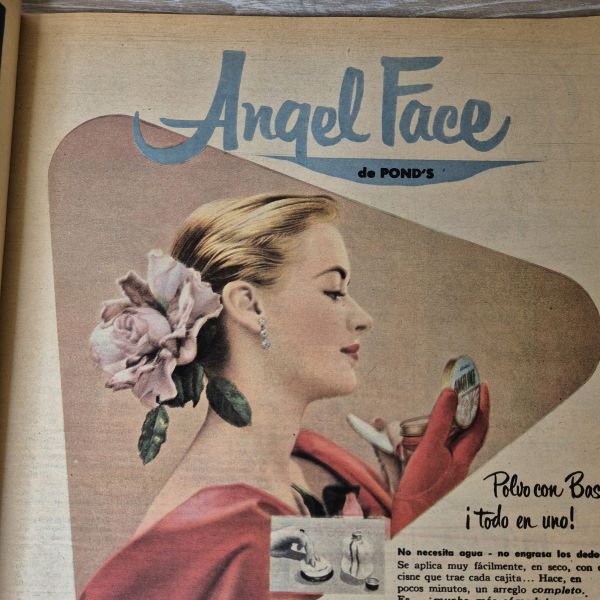
Vintage beauty advertisements often feel as if they were written for one single woman, sitting in front of her mirror. The Angel Face advertisement by Pond’s, found in a 1954 issue of Para Ti, carries exactly that atmosphere. It makes you pause, linger for a moment and imagine the soft gestures behind it.
At first glance, it appears to be a simple compact, but at that time it was actually something quite innovative: a powder and foundation combined into one single product. Today this might feel familiar, but in the early 1950s it belonged to a new vision of beauty, more practical and portable.
Reading the original 1954 advertisement
As mentioned before, this advertisement comes from a 1954 Argentine issue of Para Ti. You can read the original Spanish text in the image above, while a English translation is provided just below.
Angel Face by Pond’s
Powder with foundation — all in one!No need for water — does not grease your fingers
Applies very easily, dry, with the puff included in every compact…
Creates a complete makeup in just a few minutes.
It is… much more convenient!Does not spill
Does not dirty the inside of your handbag, nor scatter onto clothing…
You can apply it even in the darkness of the cinema:
Angel Face does not form patches, does not cake, nor “fall off”
It is… much more practical!Gives the face an adorable, refined… velvety appearance.
Never dries the skin, nor makes it oily.
Adheres perfectly and lasts longer!
For any skin type, Angel Face is much more beautifying!Angel Face comes in 6 captivating shades:
Fair – Rosy – Medium – Bronzed – Deep warm – ToastedBe modern… and be more beautiful, use Angel Face!
Ask for Angel Face in its classic blue and gold case,
or in its new “Daily Case”: a small metallic compact, charming and very affordable!
When beauty was described through experience, not ingredients
What fascinates me most is not only the product itself, but the way it was communicated. There was no ingredient list, no INCI, no scientific breakdown as we expect today. Instead, the language focused entirely on experience, on those small practical moments of everyday life.
The advertisement promised that it would not spill inside your handbag, that it could be applied even in the darkness of a cinema and that it would never dry the skin or feel greasy. Not technical claims but practical and sensory facts.
Reconstructing the formula: what Angel Face likely contained
Even without an ingredient list, we can reconstruct what was likely inside this compact by looking at the cosmetic science of the 1940s and 1950s, where formulations followed consistent structures across brands, keeping in mind that this was certainly not aligned with our beloved natural cosmetics philosophy, but rather something we are exploring as a cosmetic history curiosity.
Angel Face would almost certainly have been built on a base of talc, the ingredient responsible for that soft, velvety finish so strongly associated with vintage powders. To achieve the “cling” emphasized in the advertisement, ingredients such as zinc or magnesium stearate were widely used, helping the powder adhere smoothly to the skin and behave more like a light foundation.
For coverage and brightness, titanium dioxide would have played a central role, while iron oxides provided the different shades, tones with evocative names like Rosado (rosy), Moreno (medium or sun-kissed), Tostado (toasted, deep warm) or Bronceado (bronzed). Some formulations of the time also included kaolin clay to absorb excess oil and improve wear throughout the day.
To transform this loose blend into a pressed compact, a small amount of mineral oil or lanolin was typically added as a binder, allowing the powder to hold together while still feeling soft to the touch. And, almost inevitably, a delicate fragrance completed the formula.
A turning point: when “modern” meant synthetic
This compact sits at an interesting moment in cosmetic history, one that marks a clear transition in how beauty products were formulated.
Earlier powders often relied on ingredients like rice starch or simple plant-based materials, but by the 1950s the industry was into ingredients such as mineral oil or petrolatum (vaseline). Those ingredients were not viewed with concern, but rather as innovations as they were more stable, more resistant to spoilage, more consistent in performance and significantly more affordable to produce.
There was a sense of progress attached to these materials, a belief that science was refining beauty into something more reliable and sophisticated. From today’s perspective, especially within the world of natural cosmetics, this shift is definitely distant from current values. Unfortunately, at that time, this was seen as an improvement.
Angel Face, still alive
Angel Face did not remain frozen in time. Like many iconic bestsellers, it evolved quietly alongside the cosmetic industry, adapting to new technologies and needs.
If you are a beauty history collector, you can still find original 1950s Angel Face compacts in thrift stores or online marketplaces, sometimes preserved almost exactly like the one in this advertisement.
Over the decades, its formula transformed, incorporating silicones for a smoother glide and more advanced pigments for improved color accuracy and wear. And yes, it is still sold today.
But it belongs to a very different philosophy of beauty.
These formulations, rooted in mid-century cosmetic science, rely on ingredients and processing methods that do not align with what we now consider natural or clean beauty. At the time, those ingredients, like mineral oil or highly refined synthetics, were seen as innovative and even superior. They offered stability, affordability and consistency.
Luckily, today, our perspective is shifting.
We are moving back toward something more conscious, more transparent and more respectful of both skin and environment, rediscovering plant-based materials, simpler compositions and a deeper understanding of what we apply to our skin.
When beauty was something you felt
What I find interesting is the feeling behind this advertisement, the promise of how it would fit into someone’s life. It spoke of handbags, of evenings, small rituals and sensory feel.
About beauty as something to experience.
Looking for more cosmetic history curiosities? Click here to find all my vintage articles!