

The warm and comforting aroma of coffee is one of the first things many of us crave in the morning. I personally cannot wake up properly without the cappuccino I make with a little violet syrup for a whimsical touch.
So, what if we could bring a little of that coffee ritual into our skincare as well?
Coffee lovers will be happy to know that there are many ways to use coffee derived ingredients in DIY cosmetics. Some are interesting mainly for their cosmetic properties, others bring that unmistakable roasted aroma and a few can give us both.
And if you would love a little coffee boost in your skincare but don't actually want your face cream to smell like a cappuccino, there is space for that too.
What coffee can bring to DIY skincare
Coffee is a surprisingly interesting material for skincare, but its properties depend enormously on which coffee-derived ingredient we are actually using.
Caffeine, coffee extracts and coffee seed oil are chemically very different ingredients, so we shouldn't expect them to behave in the same way simply because they all come from coffee.
Depending on the ingredient, coffee derivatives can bring antioxidant properties, phytosterols and caffeine to a formula. For this reason they are particularly interesting for cosmetics designed for dull or tired skin, puffy areas, mature skin, scalp treatments and body massage products, including creams supporting cellulite massages.
And, of course, if you love the scent of coffee, some of those ingredients open up a completely different side of formulation: the sensory one, that is the one I especially love.
But can’t I simply use the coffee I already have at home?
Sometimes, but it depends on what you want from it.
Regular coffee can have a place in very simple homemade cosmetics, particularly as a physical exfoliating ingredient, but cosmetic grade coffee ingredients are more efficient and produced for very different purposes. They allow us to work with specific fractions of the coffee bean and in a much more controlled and safer way.
Later in the article, I’ll also show you what you can realistically do with regular coffee, from coffee scrubs to homemade extracts and coffee oil macerates, and where its limitations begin.
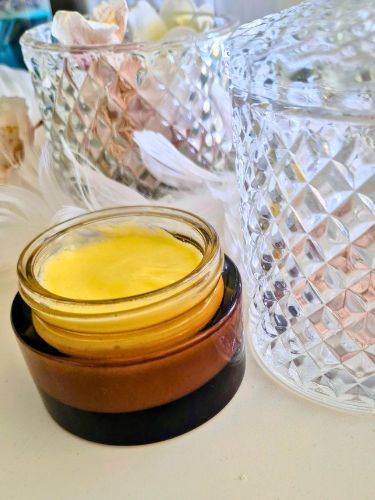
Coffee-derived ingredients for DIY cosmetics
Let’s look at the different ingredients coming from coffee that we can add to our homemade cosmetics, including their properties, how to use them and where to find them.
I’ll also come back to regular ground coffee later, because while it can certainly have a place in DIY skincare, there are a few things I think every formulator should know before adding it to a recipe.
If you’re wondering where to find these ingredients, you’ll be happy to know that they are all available at Handymade, and I’ve added a direct link to each product page throughout the article to make them easy to find. You can also use my affiliate code WONDERLAB for a 7% discount on your order.
Caffeine
Caffeine is probably the most interesting and widely used ingredient of this coffee family in natural cosmetic formulas… and it may surprise you when you first see it! In fact, cosmetic-grade caffeine is a fine white powder and doesn't smell like coffee at all.
This makes it wonderfully versatile as you can add it to a formula without turning everything you make into coffee scented skincare.
Caffeine has antioxidant properties and is a vasoactive ingredient commonly found in cosmetics formulated for puffiness, eye-area care and the appearance of cellulite. It is also used in scalp products and hair-loss treatments.
I want to highlight one important point about cellulite treatments, though: a cosmetic cream cannot make cellulite disappear. Regular manual massage can help improve its appearance by supporting local circulation and drainage, making the skin look smoother, but it does not remove the structural causes of cellulite. A body cream formulated with caffeine can complement the treatment and help improve the appearance of the area, but I would always see the massage as the central part of the ritual rather than expecting the cream alone to do the work.
For DIY skincare, I particularly like the idea of adding caffeine to a morning toner, perhaps before a little depuffing gua sha ritual followed by a gua sha specific DIY face oil.
It is usually used at around 0.5–2% in DIY formulations. My personal sweet spot is 1%, as I used in my fresh and velvety face cream recipe.
Remember: caffeine belongs in the water phase. Its water solubility is limited, so make sure it is completely dissolved before continuing with the formula rather than adding the powder directly to a finished cream, where it may not dissolve properly.
I also prefer staying around that 1% sweet spot because, as the concentration increases, getting all the caffeine properly dissolved becomes more difficult and could recrystallize.
And there’s one more reason I like caffeine: once properly dissolved, it adds practically no weight, greasiness or sticky afterfeel, so it is very easy to incorporate even into lightweight homemade skincare.
You can find cosmetic-grade caffeine here.
Green coffee bean oil
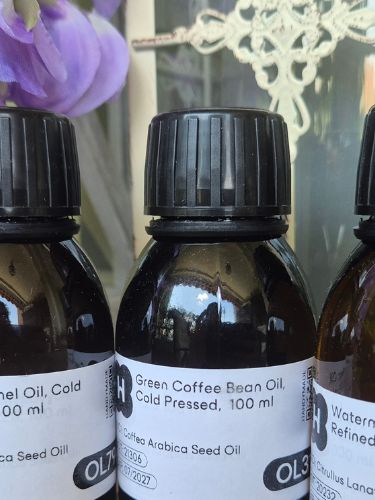
This is a completely different side of coffee.
Green coffee bean oil is cold pressed from unroasted coffee beans, so instead of isolating caffeine, we are working with the natural lipid fraction of the seed.
It has an interesting antioxidant and emollient profile and naturally contains fatty acids, phytosterols and tocopherols. Coffee seed lipids are particularly interesting for supporting skin comfort and barrier function, which makes this a beautiful oil for mature and dull skin. On top of that, it has an interesting antioxidant and anti-inflammatory potential.
It is also rich in sterols and can be a lovely addition to soothing and restorative formulas.
Its comedogenicity potential is around 2–3. So, for mature facial skincare I would happily consider this oil, but if you have blemish prone skin, it’s better to reserve it for the body, where it can be particularly interesting in a massage cream together with caffeine.
Sensorially, I really like it. It absorbs nicely into the skin and leaves a soft and velvety afterfeel.
Its scent is delicate and pleasant, slightly earthy and subtle. It can quietly remain in the background of a formulation without taking over the fragrance.
I prefer not to heat it unnecessarily so that I preserve its more delicate components.
You can find the cold-pressed green coffee bean oil here.
Coffee essential oil… and more
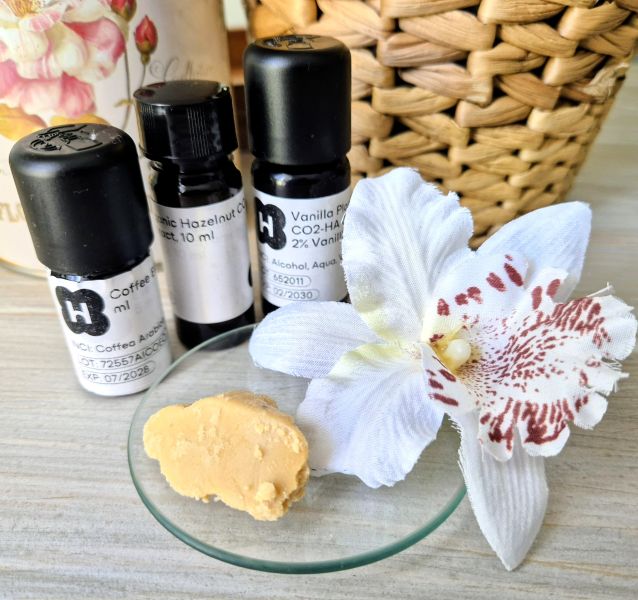
And now we arrive at the ingredient that the real coffee lovers were probably waiting for.
If the previous ingredients were mostly about what coffee can do, this is where we start talking about what coffee can smell like inside our DIY cosmetics.
Handymade sells this ingredient in this page as Coffee Essential Oil, with the INCI Coffea Arabica Seed Oil.
I already talked about this lovely oil in this article because its scent immediately caught my attention.
It has a warm and deeply aromatic coffee character that brings depth and personality to a formula. It doesn't smell like a simple or flat coffee fragrance as it feels more elegant and complex, which makes it especially interesting when you start blending it with other notes.
And it is powerful. If you combine it with other aromatic ingredients, use it sparingly so that the coffee doesn't completely cover them. In some of the blends I experimented with, around 0.1% is already enough to give depth and character while allowing the other notes to remain noticeable.
And what can you pair it with? I blended it with cocoa CO₂ extract and they are beautiful together. It is also naturally at home with vanilla and hazelnut CO₂ extracts, but you can also add a touch of coconut.
The secret, at least for the kind of gourmand fragrances I like to create, is to keep the coffee in a smaller quantity, where it can sit underneath the other notes instead of shouting over them.
This is where you can start creating fragrances that remind of cappuccino, coffee creams, hazelnut coffee or more sophisticated gourmand compositions rather than simply making something that “smells like coffee”.
Coffee CO₂ extract
There is another aromatic option that I find even more interesting from a formulation point of view: coffee CO₂ extract.
It is a little more expensive than the coffee essential oil we already explored, but it gives us a broader aromatic and phytochemical profile.
Handymade's organic coffee CO₂ extract contains aromatic coffee compounds together with polyphenols and approximately 0.2–0.7% naturally occurring caffeine. It makes it one of those lovely ingredients that sits between the sensory and active worlds.
And what about coffee itself?
Can regular coffee really be used as a cosmetic ingredient?
Yes, but it depends very much on how you use it and what you expect to extract from it.
Dry ground coffee can be used as a physical exfoliant in simple DIY body scrubs, mixed with oils, butters or an anhydrous scrub base.
It’s more suitable for the body rather than the face, because kitchen coffee doesn't have the controlled and uniform particle size of a cosmetic exfoliating powder. Depending on how it has been ground, the particles can be too harsh for delicate facial skin.
Also, keep something rather less glamorous in mind: coffee grounds don't dissolve. Washing large amounts of them down your shower or sink isn't particularly kind to your pipes and this is why I prefer using sugar in my scrubs.
Can you reuse spent coffee grounds in a scrub?
If you want to reuse the grounds left after making your morning coffee, don't take them wet from the coffee machine, mix them into an oil and then store the scrub. Why? Those coffee grounds still contain water and once you introduce a wet food-derived ingredient into what was supposed to be an anhydrous cosmetic, you also introduce a completely different microbiological situation that could make your cosmetic unsafe if preserved for more than one day.
So, unless you use them on the go, they would need to be dried very thoroughly first. Even then, drying them doesn't turn them into a sterile or standardized cosmetic raw material.
What about adding brewed coffee to creams and toners?
This is something I don't recommend for homemade cosmetics.
I wouldn't use brewed coffee as the water phase of a DIY cream, toner or gel and assume that adding a preservative automatically makes the product safe.
Coffee is a complex food-derived material that brings additional organic matter and an uncontrolled initial microbial load into the formulation, making your water based cosmetics unsafe.
So if your goal is specifically to formulate with caffeine, use cosmetic-grade caffeine instead. It is purified and concentrated and, perhaps most importantly from a formulator's perspective, you know exactly how much you are adding.
Can you make coffee-infused oil?
And what about those beautiful jars filled with coffee beans and oil that you sometimes see online?
They can certainly be lovely to look at, but it is worth understanding what you are actually making.
Caffeine and chlorogenic acids, the compounds most frequently associated with many of coffee's cosmetic properties, are relatively polar compounds and are extracted much more effectively with water or suitable hydroalcoholic solvent systems than with vegetable oil.
An oil macerate of roasted coffee can still extract some of the oil-soluble constituents and aromatic molecules from coffee, particularly if the coffee is ground or crushed rather than left as whole beans. So it isn't completely pointless, but it's more a sensory coffee macerate with a delicate coffee aroma and some lipophilic coffee compounds, rather than a meaningful source of caffeine.
And it is very different from green coffee bean oil, which comes from the bean's natural lipid fraction rather than from soaking coffee beans in another carrier oil.
That difference is quite important.
Can you make a real botanical coffee extract at home?
Here things become much more interesting.
You can make a more purposeful botanical coffee extract using water, alcohol and glycerin.
Unlike an oil infusion, a hydroalcoholic-glyceric solvent system is able to extract some of coffee's polar compounds, including caffeine and chlorogenic acids.
Green coffee is particularly interesting for this purpose because it naturally contains considerably more chlorogenic acids than roasted coffee. These compounds are valued mainly for their antioxidant activity, helping to protect the skin from oxidative stress, and they also have soothing and anti-inflammatory properties.
Roasting changes the phytochemical profile and reduces many of these chlorogenic acids, but it creates a completely different aromatic profile and those deeper roasted notes we associate with coffee.
So, I would think about the choice like this: green coffee when extracting its properties is your main objective, and roasted coffee when you also want to explore its color and scent.
However, keep in mind that a homemade extract will not be equivalent to a CO₂ extract. The extraction method is different (and, unfortunately, it cannot really be reproduced at home), so the resulting phytochemical profile will also be different. A homemade extract can still contain valuable coffee compounds, but it will generally be less concentrated, less complete and less aromatic.
And what about those beautiful jars of coffee beans soaking in oil that we often see online?
They are lovely to look at, but this is another misconception that unfortunately gets repeated quite often in natural DIY cosmetics… and one of those little false myths I like to flag when I find them!
Infusing coffee beans or ground coffee in a vegetable oil does not create something comparable to green coffee bean oil, and it doesn’t extract its cosmetics benefits because those compounds are much better extracted with water or hydroalcoholic solvents.
An oil macerate may pick up some oil-soluble and aromatic compounds from the coffee, especially if you use ground roasted coffee rather than whole beans, so it can still be interesting as a sensory macerate with a delicate coffee character, but that’s it.
And it is completely different from the green coffee bean oil we talked about earlier. Green coffee oil is obtained from the bean's own natural lipid fraction, usually by cold pressing, so it naturally contains its own fatty acids, phytosterols and other oil-soluble compounds. A coffee macerate, instead, is simply another carrier oil in which coffee has been infused.
They may all begin with the same coffee bean, but ground coffee, caffeine, green coffee bean oil, an oil macerate, a hydroalcoholic botanical extract and a CO₂ extract are not interchangeable ingredients. Each one captures a different little part of coffee and has a different strength and purpose.
This is where formulation becomes much more fascinating than simply adding something because we know its name.
I hope this guide has been useful for discovering just how much potential coffee has in DIY cosmetics, whether you are searching for its cosmetic properties, its beautiful scent, or perhaps a little of both.
And now I may need another violet cappuccino!