
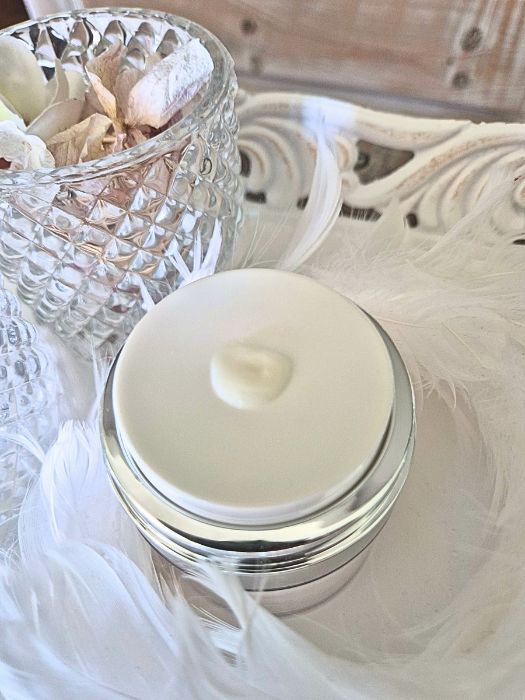
When a natural face cream is so pleasant that simply thinking about applying it makes you happy, it stops being a simple DIY cosmetic. It becomes a full experience, a complete and holistic beauty ritual.
This DIY face cream has an incredibly pleasant texture. It’s fresh, nourishing and velvety at the same time, with a lovely natural aroma that makes me want to reach for it again and again. The scent comes from a lovely essential oil blend I created and that I’ll share with you later.
I formulated this cream especially for the beginning of fall, when the skin can feel stressed and a little more reactive after summer and starts craving hydration, comfort and barrier support, while still wanting something light and fresh.
I designed the lipid phase to feel light and balanced rather than greasy, making this cream especially lovely for combination skin and skin that needs soothing care, barrier support and extra hydration without heaviness.
The Secret Behind a Fresh and Velvety Texture
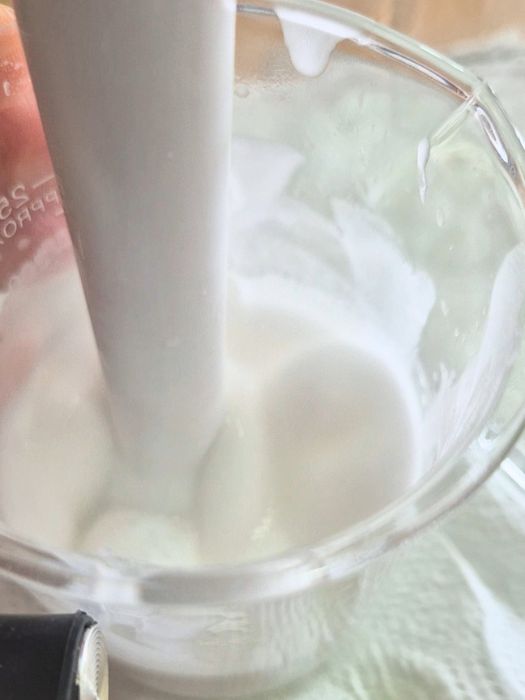
The texture is probably my favourite part of this cream.
I wouldn’t define it as a gel-cream, but it has a similar freshness and light consistency, while still leaving the skin comfortably nourished and velvety.
The secret lies in the carefully built fatty phase and the precious ingredients around it.
If you have followed Lily in WonderLab for a while, you probably know how much attention I give to the balance between different oils. I’m not a fan of one-oil-only creams, and I consider them one of the most common formulation mistakes.
Different oils bring completely different textures, spreading behaviours and after-feels. A cream becomes much more interesting when we balance light, silky and richer lipids instead of asking one single oil to do everything. Also, it will last longer on the skin thanks to the different absorptions.
A Carefully Built Oil Phase
The oil phase begins with squalane, one of my favourite ingredients when I want a lightweight elegant and silky feel.
Squalane has excellent skin affinity. It softens the skin and supports the skin barrier feel without making the formula heavy.
Then comes macadamia oil, my little secret weapon whenever I want to create a more velvety texture. Macadamia oil is especially interesting because of its content of palmitoleic acid, a fatty acid that is relatively unusual in vegetable oils and gives macadamia its characteristic smooth and nourishing sensory profile.
I also added the fantastic watermelon seed oil, one of my latest finds on Handymade.
It’s quite lightweight and particularly rich in linoleic acid, an essential fatty acid that plays an important role in maintaining a healthy skin barrier. Linoleic acid is involved in the formation of important epidermal lipids, including ceramides, and an altered lipid balance has been associated with eczema, dermatitis and clogged pores.
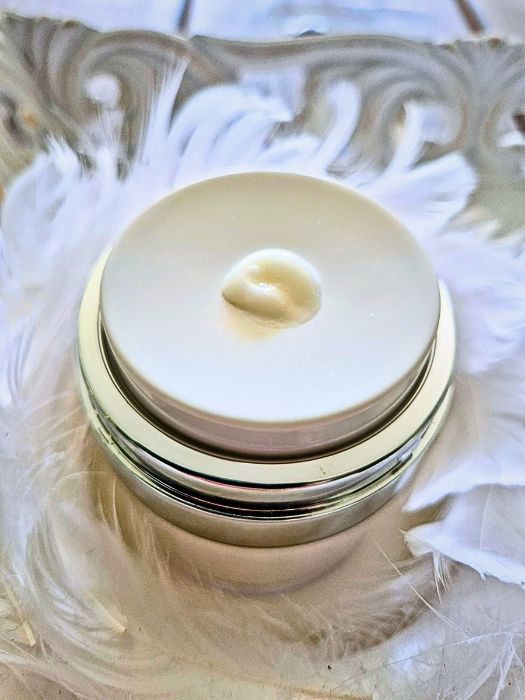
Then comes one tiny ingredient that makes a surprising difference: castor oil at just 0.5%.
I wouldn’t use much more in this type of facial cream because castor oil can quickly become heavy, sticky or greasy. But at this dosage, I find that it helps the comfortable feeling of hydration last a little longer without making the cream oily.
And believe me, this little trick really makes a difference!
Finally, 1% mango butter adds a subtle touch of creaminess without turning this into a heavy butter cream.
Sodium PCA: One of the Secrets Behind the Skin Feel
The water phase also has a wonderful ally behind the beautiful texture of this cream: Sodium PCA (50% version).
Sodium PCA is an excellent humectant and is related to the skin’s own Natural Moisturizing Factor, or NMF. It helps attract and retain water, supporting hydration and leaving the skin soft and comfortable.
I love what it does sensorially in a formula, contributing to a fresh and amazing texture.
The Real Stars: Chia Seed CO₂ and Guggul CO₂ Extract
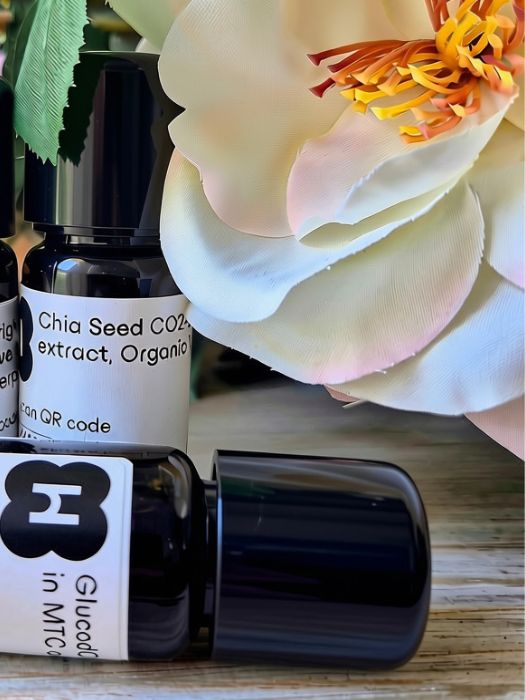
The texture makes this cream a pleasure to use, but the ingredients that make it especially interesting from a skincare point of view are Chia Seed CO₂ Extract and GlucodOX Liquid Guggul Extract.
Both can be found at Handymade, and considering how unusual and precious these ingredients are, I find their prices surprisingly accessible.
Chia Seed CO₂ Extract
Chia Seed CO₂ Extract is soothing and maintains a healthy skin barrier.
It is rich in essential fatty acids, especially alpha-linolenic acid and linoleic acid.
We already talked about the importance of linoleic acid for the skin barrier, and chia brings another beautiful lipid profile to the formula. This is exactly the type of ingredient that makes sense in a cream designed for skin that feels a little stressed after summer.
GlucodOX Liquid: Guggul Extract in MCT Oil
And then there is GlucodOX Liquid, one of the more unusual ingredients in this formula.
It is a CO₂ extract obtained from the resin of guggul, containing interesting compounds called guggulsterones and guggulsterols, which have been studied for antioxidant, soothing and regenerative activity.
This is why I find GlucodOX especially interesting in formulas designed to support mature, stressed or reactive skin.
Its presence adds a meaningful antioxidant and anti-ageing dimension to the cream and complements the barrier-supporting lipid phase beautifully.
It is also interesting for skin prone to irritation and redness, which is another reason why I wanted it in this post-summer formula.
A Little Caffeine Secret
Another little secret hidden inside the formula is 1% caffeine.
One reason I like it in facial products is its relationship with cutaneous microcirculation, which makes it particularly interesting for skin that looks tired or slightly puffy.
And What About the Scent?
The scent is beautiful. Fresh and elegant, with just enough depth underneath to make it more interesting than a simple citrus-floral blend.
I combined the fresh citrus notes of bergamot, the soft and powdery floral elegance of Rosa centifolia, and just a tiny touch of frankincense.
For bergamot, I use the furanocoumarin-free version, also known as Bergamot FCF. This is the version I prefer for leave-on facial cosmetics because it is not phototoxic.
For rose, I use the beloved Rosa centifolia essential oil diluted to 10% I talked about in this article, where I also explain why this is the version we should use in DIY cosmetics. It’s much more practical than the expensive concentrated oil, easier to dose accurately, more economical and perfect for small DIY batches like this one.
Finally, I add just a little frankincense essential oil.
Its warm, woody and resinous character completes the perfume without overwhelming the bergamot or rose. That tiny amount makes the scent feel complete.
DIY Face Cream Recipe
Phase A
Distilled water — 70.58 g (70.58%)
Xanthan gum — 0.20 g (0.20%)
Glycerin — 2 g (2%)
Sodium PCA 50% — 3 g (3%)
Caffeine — 1 g (1%)
Phase B
Olivem 1000 — 5 g (5%)
Macadamia oil — 3 g (3%)
Squalane — 4 g (4%)
Castor oil — 0.5 g (0.5%)
Phase B1
Watermelon seed oil — 4 g (4%)
Mango butter — 1 g (1%)
Phase C
GlucodOX Liquid — 2 g (2%)
Chia Seed CO₂ Extract — 2 g (2%)
Tocopherol — 0.5 g (0.5%)
Rosa centifolia Essential Oil 10% — 0.28 g (0.28%)
Bergamot FCF Essential Oil — 0.28 g (0.28%)
Frankincense Essential Oil — 0.06 g (0.06%)
Cosgard — 0.6 g (0.6%)
All the ingredients used in this formula can be purchased from Handymade. Use my affiliate code WONDERLAB for a 7% discount and don’t forget to add the free gift they give for every order!
How to Make the Face Cream
- Start by preparing Phase A. Place the water and caffeine in a heat-resistant beaker and warm gently until the caffeine has completely dissolved.
In another beaker, premix the xanthan gum with glycerin until you have a smooth mixture with no dry clumps.
Pour the caffeine-water mixture over the xanthan and glycerin while stirring. Allow the xanthan gum to hydrate and the gel to develop. You can simply leave it for a few minutes or use a mini mixer to speed up the process.
Once the gel has formed, add the Sodium PCA and mix well. - In a separate heat-resistant beaker, combine the Phase B ingredients: Olivem 1000, macadamia oil, squalane and castor oil.
- Heat Phase A and Phase B separately until they reach approximately 70–75°C, making sure that the Olivem 1000 has completely melted.
- At the end of the heating phase, add the watermelon seed oil and mango butter from Phase B1 to the oil phase. I add them at this stage to expose them to high temperatures for as little time as possible.
- Make sure Phase A and Phase B are at approximately the same temperature, around 70–75°C. Pour Phase B into Phase A. Use an immersion blender for approximately 2–3 minutes, until the emulsion has formed and looks homogeneous. Then, continue stirring occasionally with a spatula while the cream cools.
- Once the temperature has dropped below 40°C, add the Phase C ingredients one by one and stir thoroughly after every addition.
- Check the pH, that should be around 5.0–5.5. Adjust it if necessary. Your face cream is ready to enjoy!
My Favourite Packaging for This Cream
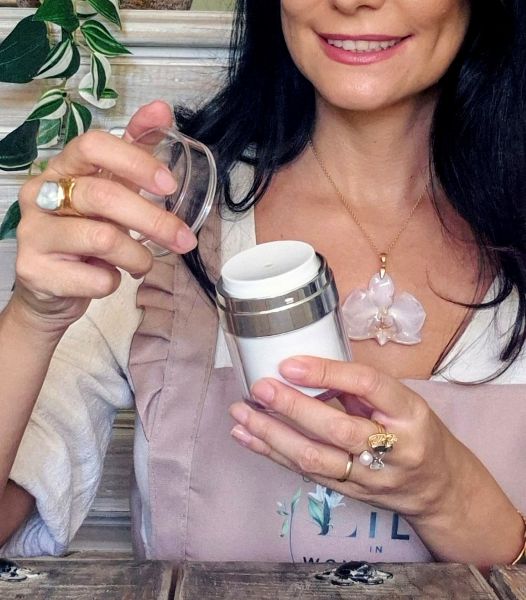
I added mine to this beautiful airless jar from Handymade, and I love it for this type of formula.
It is hygienic and helps reduce repeated contact between the cream, your fingers and the outside environment. You simply press the top and the right amount of cream appears. So satisfying!
Of course, airless packaging does not replace proper preservation, but it is a very practical choice for a preserved emulsion like this one and helps protect the formula during everyday use.
My Little Secret for a Better Natural Fragrance
And now one last tip about the scent…
Essential oils can absolutely be added to a cream one by one when you make it, and you will already get a lovely fragrance.
However, there is another little trick I use.
If you premix the aromatic ingredients in a small bottle and leave the blend to rest for one or two weeks, the fragrance becomes noticeably more harmonious.
The aromatic molecules have time to meet and settle together, and instead of smelling like separate notes added at the last minute, the perfume starts to feel like one composition.
Adding the essential oils separately is faster, but if you use this little trick, you will notice the difference. I almost always do it now.
Since we are working with very small quantities, I usually multiply the fragrance formula by five or even ten and prepare a small bottle in advance.
For example, to make enough fragrance for five batches of this cream, mix:
Rosa centifolia Essential Oil 10% — 1.40 g
Bergamot FCF Essential Oil — 1.40 g
Frankincense Essential Oil — 0.30 g
This gives you 3.10 g of natural fragrance blend.
Leave it to rest in a small, well-closed dark bottle.Then, whenever you prepare another 100 g batch of the cream or any other similar DIY cosmetic, simply add 0.62 g of your premixed fragrance blend in Phase C.