

This little bottle of oil may quickly become your favorite ally when you have to deal with one of those sudden, angry and irritated pimples.
Pimples can be a struggle for acne-prone skin, but they can also appear on oily or combination skin long after the teenage acne years are over. You might no longer experience regular acne breakouts, but every now and then, especially during hormonal changes, around your period, in stressful moments, or perhaps after a few too many days of chocolate and fried food… there it is: that red, irritated pimple that even hurts when you touch it.
This is exactly what happens to me. I suffered from acne in the past, and today I have combination skin. I don't normally struggle with acne anymore, but hormonal changes and certain foods can still trigger the occasional pimple.
I formulated this little DIY blemish oil for exactly those moments.
I tested it personally on one of those very red, swollen, irritated pimples and I was very impressed by how quickly it worked for me. By the next day the redness and swelling had gone and the spot didn’t look angry anymore.
I don't want to be without this little bottle anymore!
A different approach to pimple care
When we think about pimple treatments, one of the first things that comes to our mind is often something strong and drying.
For years, this was almost the standard approach: dry the spot as much as possible and somehow “attack” it.
Unfortunately, that can also mean stripping an already irritated area and leaving the surrounding skin dry and even more compromised.
This oil takes a completely different approach. Instead of punishing the skin, I wanted to give it a soft veil of comfort while still addressing the particular needs of a blemish.
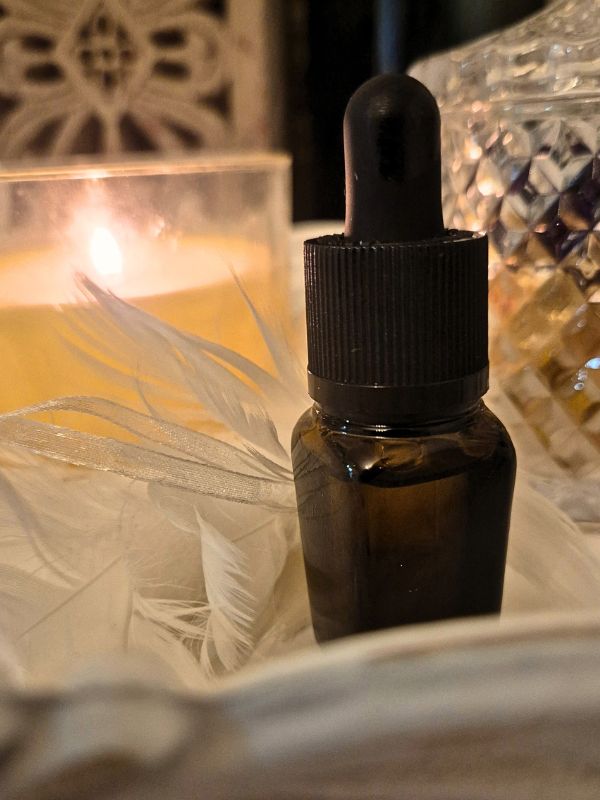
The formula combines antimicrobial ingredients with soothing and regenerative actives, helping to care for the irritation around the blemish while supporting the skin as it returns to its normal state.
And yes, there is an antimicrobial component too, because that is an important part of the formula.
The antimicrobial CO₂ blend
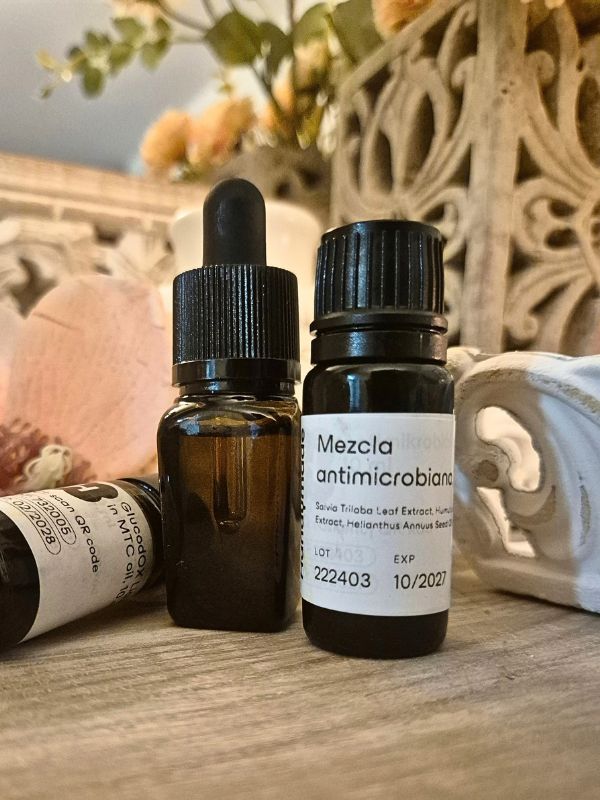
For this recipe I used 1% Antimicrobial Blend CO₂ from Handymade, a concentrated botanical blend that I selected because it works from several interesting angles at once.
It combines concentrated CO₂ extracts of hops, licorice, sage, oregano, clove, Curcuma xanthorrhiza, ajowan and other botanical components, bringing together antimicrobial and soothing properties.
What makes this ingredient particularly interesting for blemish-prone skin is that some of its components have an interesting relationship with acne-prone skin.
Hops are perhaps one of the most fascinating. Hop extracts have demonstrated antimicrobial activity against the microorganisms involved in acne.
Then there is licorice, another ingredient I particularly like here. Licorice compounds are famous for their acne soothing properties, helping with red, swollen and irritated blemishes.
Why I added guggul extract
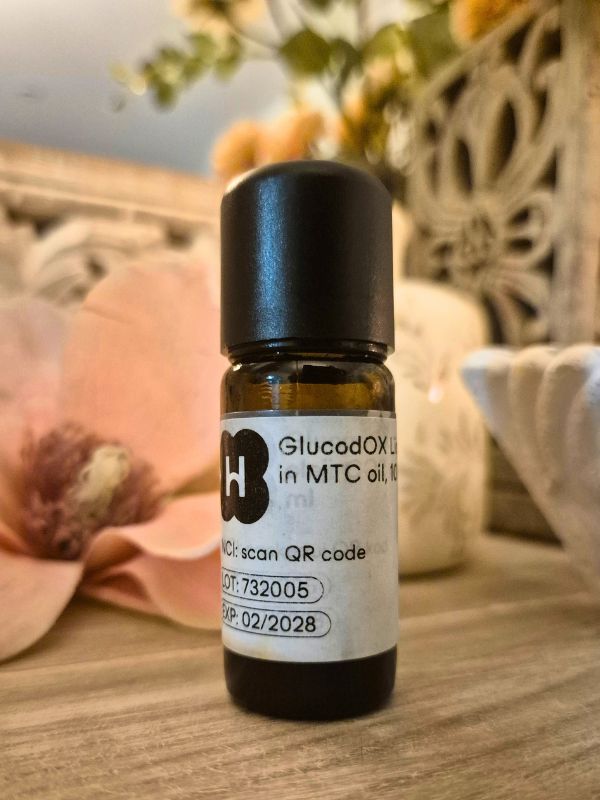
On top of that, I added 3% GlucodOX Liquid, the same guggul extract I used in my beloved face cream.
And there is a very specific reason why I wanted it here: Guggul has very interesting soothing, anti-inflammatory and regenerative properties, and is traditionally used for acne prone skin.
When we have an angry pimple, it is easy to focus exclusively on antimicrobial ingredients, but I think we sometimes forget the other half of the problem: the skin itself has been irritated and needs to recover… and supporting that recovery matters!
We don't simply want the spot to dry out, we also want the redness and swelling to calm down, while giving the surrounding skin what it needs to return to normal as gracefully as possible. Otherwise, even after the pimple itself begins to disappear, we may still have redness and a visible spot mark for days.
That regenerative aspect is one of the main reasons guggul earned its place in this formula.
Why use an oil on a pimple?
Some of you may find it strange to see an oil-based spot treatment for pimples.
But oil itself isn't necessarily the problem. What matters enormously is which oils you choose.
There is also a practical formulation reason for using an oil base here: both the Antimicrobial Blend CO₂ and the guggul extract are oil-soluble.
Choosing a linoleic acid-rich oil
For the main carrier oil, I wanted an oil particularly rich in linoleic acid.
Linoleic acid is especially interesting for oily, blemish-prone and acne-prone skin, helping to regulate sebum production and avoid clogged pores.
For this recipe I chose grapeseed oil, which has a very high linoleic acid content (around 70%).
You can also experiment with other oils naturally rich in linoleic acid, such as raspberry seed oil, passion fruit oil and pumpkin seed oil.
Jojoba and Squalane
I then added jojoba oil, which is particularly compatible with the skin.
And then we have squalane, one of those ingredients I reach for again and again. It is extremely lightweight, has excellent skin compatibility and helps support the skin barrier. Also, it supports the absorption of actives.
Bisabolol and Vitamin E
Bisabolol adds another layer of soothing support. It is one of my favorite ingredients when I want to formulate for irritated or uncomfortable skin because of its well known calming properties, and it fits beautifully with the philosophy behind this formula: addressing the blemish while being gentle with the skin around it.
Finally, I added vitamin E (tocopherol), which is almost indispensable in a blend like this because it helps slow the oxidation and rancidity of the vegetable oils.
Remember, though, that vitamin E is an antioxidant, not a preservative. In this completely anhydrous formula we don't need a preservative because there is no water phase, but we still want to protect those delicate unsaturated oils from oxidation.
DIY blemish oil formula
- Grapeseed oil: 65 g / 65%
- Jojoba oil: 20 g / 20%
- Squalane: 10 g / 10%
- GlucodOX - guggul extract: 3 g / 3%
- Antimicrobial Blend CO₂ extract : 1 g / 1%
- Bisabolol: 0.5 g / 0.5%
- Vitamin E (tocopherol): 0.5 g / 0.5%
All the ingredients used in this recipe can be found at Handymade. You can use my affiliate code WONDERLAB for 7% off your order.
How to make it
This is one of those wonderfully simple formulas where the ingredients themselves do most of the interesting work:
- Weigh all the ingredients accurately into a clean beaker and mix until completely homogeneous. The Antimicrobial blend is quite dense, so take your time stirring it in until it has completely dissolved and the oil looks uniform.
- Transfer the finished blemish oil into a small bottle, ideally one with a dropper so you can dispense just a tiny amount at a time. I especially love this square bottle from Handymade… I liked it so much that I ended up getting it in several different sizes! I used it for my raspberry and vanilla hydrating mist as well!
How to use this blemish oil
Apply a very small amount directly onto the pimple two or three times per day.
I like applying a toner or hydrosol before using facial oils and I recommend using witch hazel hydrosol in this case.
You can use it for blemishes on the face or body, but this formula could also be used for those small blemishes that sometimes appear after waxing.